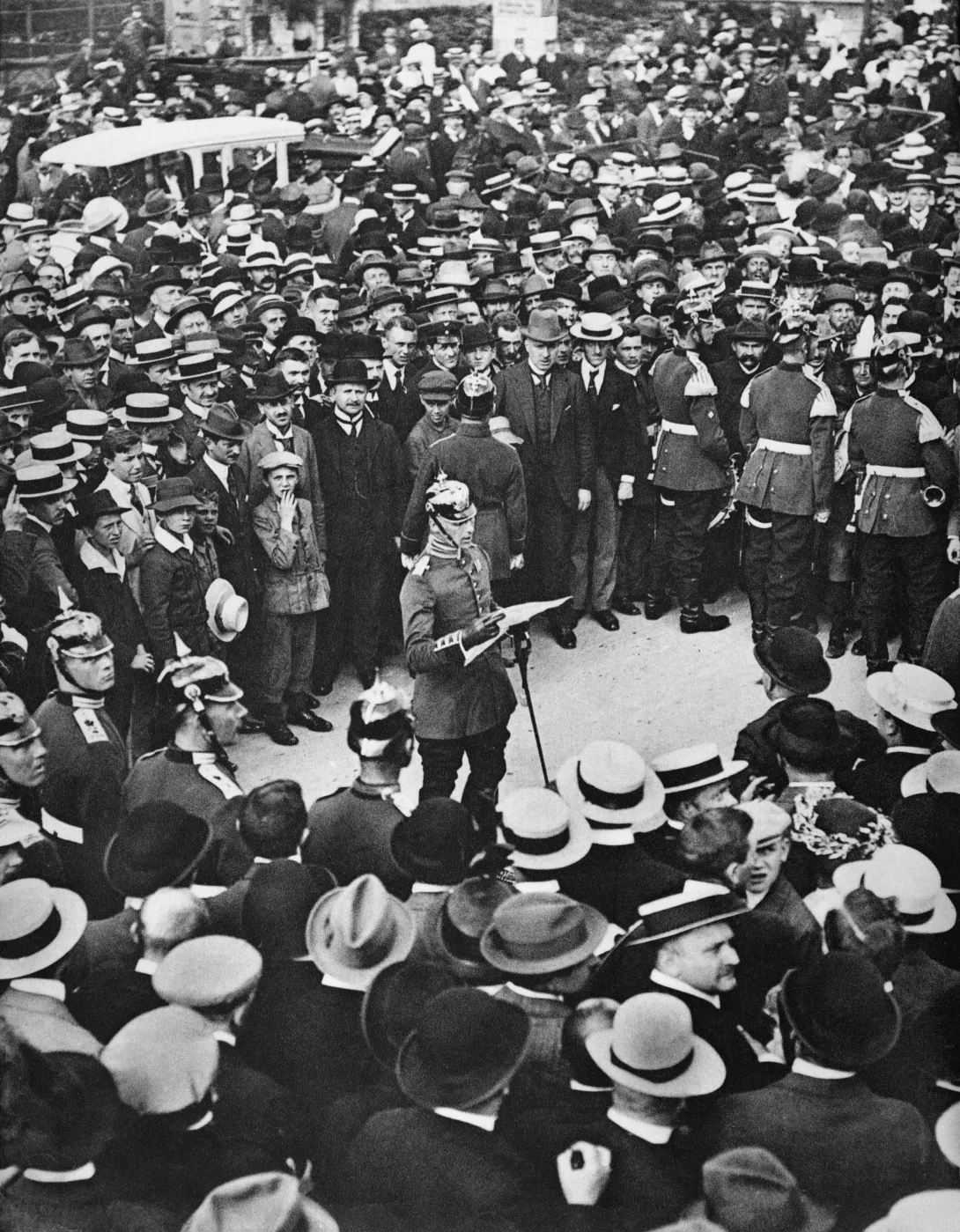
A thought pattern that has haunted me for a while now is a tendency to unconsciously anthropomorphize phenomena. The pervasiveness of this category of false premises came to my attention as I tried to understand the politics of the Great War in Europe. It is a tendency that has increasingly come to bother me, both when trying to think for myself, and when I speak with and listen to others. It is strange that such a poor way to analyze the behavior of complex systems, including but not exclusively the decision making processes of groups of people, can appear so convenient and satisfying. It is so frustratingly ineffective to explain the split-second decision of an individual German cavalry man to spur his horse and ride straight into a mountain of already dead German soldiers in front of a Belgian fortress by casually establishing that, somewhere, far from that place, some time before that, Kaiser Wilhelm II, formally authorized General Moltke (the Younger) to attack "France". I use quotation marks here to highlight the proposition that, in reality, not even Moltke's closest associates would necessarily have taken much interest in either Moltke's opinion or France, whatever a proper definition of France in this context might be, under different circumstances. Even worse, it is not uncommon to hear phrases like "Germany decided to invade France", a completely nonsensical phrase if one only scratches the surface of its signification, which points towards the root of the problem: Which entities can actually make decisions?
Having worked closely with the UN, in EU projects and generally in large organizations within both the public and private spheres, this question has become increasingly central throughout my professional life, too. This leads me to object to describing decisions made by anything beyond the individual, and to conclude that human interaction must be viewed in context, and rather as a network of locally connected nodes, through which, at every instant, the effects of the behavior of every single individual node ripple outwards, from neighbor to neighbor, as chains of local responses. Not unlike the events following a droplet hitting a water surface. Just as the droplet does not itself physically constitute the ripples, which are rather the elements of the resulting chain reaction, decision-making processes are not themselves decisions. I.e., the total effect of all the nodes in the network, pushing and pulling each other around as a consequence of the first few water molecules having initially been hit by the droplet, is a fundamentally different thing from the instantaneous dynamics of each individual molecule. Moreover, in the case of human interaction, every person's behavior or response thereof, at every single point in time, is based on a substantial amount of guesswork regarding this very process. In other words, both behaviors and responses are actions by an individual, or inaction for that matter, based on what that individual believes all other, for them relevant, individuals might be up to, and how that person believes they will react faced with all the likely sequences of behaviors surrounding them.
So, Moltke's point of view in the moment the formal order to invade France was indeed likely to be shaped by, among many other things, what he believed would be the direct and indirect effects of the imminent actions of Nikolai II, which he could only speculate what they were. However, a much more nuanced picture would emerge if we could understand to what extent he took e.g. Nikolai II's individual actions into account, and what concrete significance he ascribed to what he thought that the ensuing direct and indirect effects of these actions were likely to be. The cavalry man, in his turn, perhaps a husband and father at home, made a series of decisions leading him to the front of the Belgian fortress in the wake of both the Kaiser's, Moltke's and Nikolai II's actions, but were the cavalryman's decisions at any point primarily responses to, either his assessment of the likely actions of any particular warring royal cousin, or even, what he thought of Moltke? Did he even know who Moltke or even who Nikolai II were when this series of decisions had already put him in a position where him ending up in Belgium was inevitable?
Comments